Kitchen Conversion Chart
Cups, millilitres, grams, ounces and oven temperatures in one place. Australian and US measures are different, so we show both.

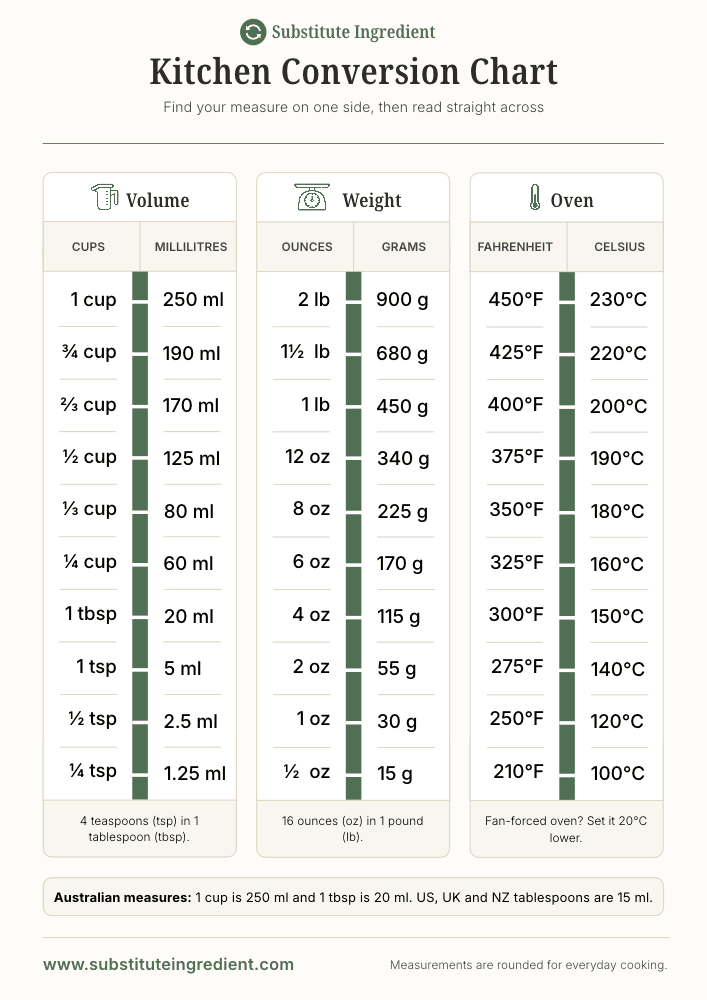
Free printable chart
A one-page cheat sheet with the three conversions you reach for most: cups to ml, °C to °F, and oz/lb to g/kg. Print it and pop it on the fridge. No email, no sign-up — just the file.
Download the PDFKitchen Conversion Chart · PDF · 1 page · 106 KB
Spoon and cup sizes by country
The same words mean different volumes depending on who wrote the recipe. Check this first if a bake comes out wrong.
| Measure | Australia | United States | United Kingdom |
|---|---|---|---|
| ¼ teaspoon | 1.25 ml | 1.25 ml | 1.25 ml |
| ½ teaspoon | 2.5 ml | 2.5 ml | 2.5 ml |
| 1 teaspoon | 5 ml | 5 ml | 5 ml |
| 1 tablespoon | 20 ml | 15 ml | 15 ml |
| 1 cup | 250 ml | 240 ml | 250 ml (metric cup) |
| 1 fluid oz | Not used | 30 ml | 28 ml |
Cups to millilitres
Australian and US cups match at the smaller measures and drift apart from the half cup up. The shaded cells are where they differ.
| Cups | Australia (ml) | United States (ml) |
|---|---|---|
| ¼ cup | 60 ml | 60 ml |
| ⅓ cup | 80 ml | 80 ml |
| ½ cup | 125 ml | 120 ml |
| ⅔ cup | 170 ml | 160 ml |
| ¾ cup | 190 ml | 180 ml |
| 1 cup | 250 ml | 240 ml |
Shaded cells are where the Australian and US measure are not the same.
Fluid ounces to millilitres
A fluid ounce measures volume, not weight, and the US and imperial versions are not the same size.
| Fluid ounces | United States (ml) | UK imperial (ml) | Same as (US) |
|---|---|---|---|
| 1 fl oz | 30 ml | 28 ml | No whole cup equivalent |
| 2 fl oz | 60 ml | 57 ml | ¼ cup |
| 4 fl oz | 120 ml | 114 ml | ½ cup |
| 6 fl oz | 180 ml | 170 ml | ¾ cup |
| 8 fl oz | 240 ml | 227 ml | 1 cup |
A US fluid ounce is 29.6 ml and a UK imperial one is 28.4 ml, so the gap widens as the quantity grows: a US pint is 16 fl oz (475 ml), while a UK pint is 20 fl oz (568 ml). Australian recipes use millilitres, but anything written before metrication uses the imperial column.
Oven temperatures: Celsius to Fahrenheit
Fan-forced ovens run about 20°C hotter, so reduce the temperature by 20°C if a recipe is written for a conventional oven.
| Celsius | Fahrenheit | Fan-forced | Description |
|---|---|---|---|
| 100°C | 210°F | 80°C | Warm |
| 120°C | 250°F | 100°C | Very slow |
| 140°C | 275°F | 120°C | Slow |
| 150°C | 300°F | 130°C | Slow |
| 160°C | 325°F | 140°C | Moderately slow |
| 180°C | 350°F | 160°C | Moderate |
| 190°C | 375°F | 170°C | Moderately hot |
| 200°C | 400°F | 180°C | Hot |
| 220°C | 425°F | 200°C | Very hot |
| 230°C | 450°F | 210°C | Very hot |
| 240°C | 475°F | 220°C | Extremely hot |
Ounces and pounds to grams and kilograms
Weight is the one measure that travels well — an ounce is an ounce everywhere. Only the rounding changes.
| Imperial | Metric |
|---|---|
| ½ oz | 15 g |
| 1 oz | 30 g (28 g exact) |
| 2 oz | 55 g |
| 4 oz | 115 g |
| 6 oz | 170 g |
| 8 oz | 225 g |
| 12 oz | 340 g |
| 1 lb (16 oz) | 450 g |
| 1½ lb | 680 g |
| 2 lb | 900 g |
| 2.2 lb | 1 kg |
Why Australian and US cups aren't the same
Australia went metric and rounded its cup to a clean 250 ml, while the US cup stayed at the older 240 ml. The tablespoon is the bigger trap: an Australian tablespoon is 20 ml against 15 ml in the US, the UK and New Zealand, which makes an Australian tablespoon four teaspoons rather than three. One spoonful of butter won't ruin anything, but four tablespoons of flour in a cake batter is a third of a cup out.
Most recipes written in American outlets use US cups, so if you're cooking from an American site in an Australian kitchen, read the US column. Ingredient names differ too — see what ingredients are called in each country.
Cups don't convert to grams the same way for every ingredient
There is no single cups-to-grams number, because a cup measures space and grams measure weight. A cup of plain flour is about 120 g, a cup of caster sugar is about 200 g, and a cup of honey is heavier again. The tables above convert cups to millilitres, which is a fixed relationship — cups to grams depends entirely on what is in the cup.
For weights for a specific ingredient, along with what to use when you've run out of it, browse the ingredient guides.
Free printable chart
A one-page cheat sheet with the three conversions you reach for most: cups to ml, °C to °F, and oz/lb to g/kg. Print it and pop it on the fridge. No email, no sign-up — just the file.
Download the PDFKitchen Conversion Chart · PDF · 1 page · 106 KB
Frequently asked questions
How many ml are in a cup?
It depends where the recipe is from. An Australian metric cup is 250 ml, a US cup is 240 ml, and a UK metric cup is 250 ml. The difference is small in a soup and very noticeable in a cake.
Is an Australian tablespoon the same as a US tablespoon?
No. An Australian tablespoon is 20 ml, while a US, UK and New Zealand tablespoon is 15 ml. That makes an Australian tablespoon four teaspoons rather than three.
What is 180°C in Fahrenheit?
180°C is 350°F in a conventional oven. If your oven is fan-forced, set it to about 160°C instead.
How many grams are in an ounce?
An ounce is about 28 g. Most recipes round it to 30 g, which is close enough for everyday cooking.
Is a cup the same as 250 ml?
In Australia, yes — the metric cup is exactly 250 ml. In the United States a cup is about 240 ml, so a US cup is slightly smaller.
Conversions are rounded for everyday cooking. See our disclaimer.